
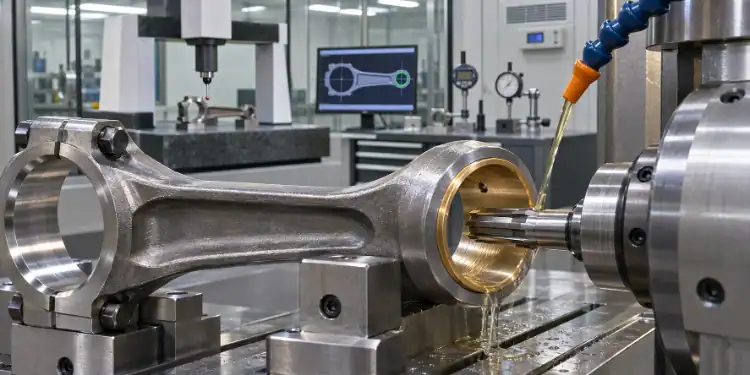
The fit between piston pin and bushing decides how long a small end lasts, and machining decides that fit — the press only positions the sleeve. Seat the bushing straight, cut its bore to final size after it is installed so the cut sees the real assembled geometry, line its oil hole up with the feed hole in the rod, and the joint runs quiet for its design life. Press a sleeve in, ream it freehand, and hope the hole lands round and centered, and the pin starts rocking almost at once: a light tap at idle first, blamed on everything else, then a worn small end, then a teardown. Four steps control the whole outcome — bore preparation, press-fit alignment, the finishing cut after installation, and verification of roundness and alignment before the rod leaves the shop.
Ruizheng has run that sequence on engine-side linkage work out of Foshan since 2013, alongside the custom crankshafts the rods bolt to. Rods pass first-piece, in-process and pre-shipment checks, the paperwork is written under ISO 9001, and the measurements happen in a temperature-controlled room. Walk the bore through those steps and you start to see why most small-end complaints in a rod supplier’s quality folder are process photos taken at the wrong moment.
What the Bushing Is Actually Holding
An oscillating joint is harder to feed oil than a spinning one
The big end turns a full revolution every crank revolution, pulling fresh oil through the clearance as it goes. The small end never completes a revolution — the piston pin rocks back and forth through a limited angle, hundreds of cycles a minute. An oil film that thrives under full rotation can starve in that rocking contact, because the pin never sweeps far enough to draw new oil in. This is why the surface in a small end needs a defined finish and a defined clearance instead of a shop’s favorite phrase, nice and tight.
Diesel turns every small error into a big one
A diesel pushes harder on the pin every power stroke, so the joint runs hotter and marginal conditions show up sooner. A clearance mistake a petrol engine swallows quietly surfaces early in a diesel on continuous load — fleet trucks, marine, generator sets. Buyers sourcing rods for that kind of duty should expect the bore records to run tighter than a passenger-car equivalent, not looser.
Damage from a loose small end travels both directions
Once clearance grows, the pin hammers inside the bore. The bosses crack under the repeated impact, the bore goes oval, and the next bushing job is unreliable before it starts because the housing itself is stretched. Up the same play rocks the piston against the liner; down, the rod carries abnormal bending into the big end. The bushing costs almost nothing. What it takes with it when it goes is the expensive part.
How Machining Controls What the Press Cannot
The rod bore gets cut true before the sleeve ever arrives
The bore in the rod body comes off the CNC lathe to the interference the bushing material needs, taken against a datum, with roundness already under control. A sleeve pressed into an out-of-round housing finishes out-of-round in the same pattern — press-fit copies the parent bore and amplifies it rather than correcting it. Alignment has the same unforgiving logic: pressing straight is not a thing the press guarantees by itself, since force readings prove something slid in, not that it went in square. Geometry gets checked right after seating for exactly that reason.
The finishing cut happens after installation, and that is the whole argument
This step separates a machined fit from a pressed-and-hoped one. The bushing bore reaches final diameter after seating, so the cut sees the real assembled geometry, distortion included. Skip it and the running surface keeps a record of every push the press made. Done properly, stock comes off light with heat kept down, because a bushing worked hot softens and surrenders the hardness the material was chosen for in the first place.
The oil hole gets lined up and the result gets measured
The hole in the bushing must land where the rod feeds oil, or lubrication is blocked at the precise place it is needed — an easy mistake, because nothing about a misaligned hole shows at room temperature. Then the finished bore gets measured: diameter, roundness, its relationship to the rod’s datum. Ruizheng’s finished checks run on a Zeiss CONTURA coordinate machine and the shop’s runout and concentricity bench, in the temperature-controlled room, so the value on the report describes the rod that ships.
What to Ask a Rod Supplier About Small-End Bores
Bushed and reamed to size costs nothing to write in a quotation. The questions below cost the same to ask, and the answers separate shops that finish bushings from shops that install them.
| The question | The answer that means the step exists |
| Where does the bore go round? | On the lathe against a datum, before the sleeve goes in |
| When does the bushing reach running size? | After seating, light finishing cut, heat controlled |
| How is the oil hole verified? | Checked against the rod’s feed position, not eyeballed at pressing |
| What proves the finished bore? | Diameter plus roundness and alignment values, on named instruments |
| Where were those readings taken? | Temperature-controlled room, parts stabilized before measuring |
Rods rarely ship alone — they come with piston and crank assemblies built on the same fit logic, so a buyer ordering a matched set gets more from asking one documentation question for the whole rotating assembly than three separate ones piecewise. The pin diameter, the duty cycle and the clearance the build actually intends make a complete first message, and the contact page is where it lands a real answer about how that bore will be made and measured. And when the failure being chased is fatigue rather than wear, the material and heat-treatment side of the same rod is a separate story, covered properly in this write-up on rod material and dimensional control.
FAQ
Can a worn small end be saved by pressing in a new bushing?
Usually, if the rod body bore is still sound. The bosses need to be crack-free and the bore has to hold roundness under the new interference — once the housing is stretched oval, a fresh sleeve simply copies the damage and the knock comes back. A measurement session decides that in an afternoon; a teardown discovers it the expensive way.
Why ream after the bushing is pressed instead of before?
Because pressing distorts. However carefully a sleeve goes in, the bore it presents afterward is not the bore that existed beforehand. The finishing cut removes exactly that discrepancy, which is also why reaming before installation, however tidy on the bench, cannot promise a round running surface.
What clearance should a piston pin run in the small end?
Full-floating pins lap to close working clearance measured on the actual pin and bore together, since the joint lives on the oil film and the circlips do the retaining; semi-floating setups press a controlled interference instead. The honest figures come from the engine’s own specification rather than from any blog, and a custom builder’s reliable move is sending pin and bore records together and having the fit calculated on both.

