
Weigh two connecting rods, get them agreeing to a tenth of a gram, and the engine can still run rougher than one built on a heavier set. That sounds like nonsense until you remember what a rod actually is. Not one mass doing one job. The small end hauls the piston up and down, reversing twice every crank revolution. The big end swings around the crankpin as rotating mass. A scale reads the sum of both. The engine never does — it cares about each end separately. Weight matching done right means measuring the ends apart, keeping the spread across the set small at each end, and writing the numbers down. Match to the lightest end by end and the set drops a vibration source that bench weighing will never see.
This changes the question worth asking a connecting rod supplier. Skip “are your rods the same weight.” Ask to see the per-end weighings and where correction material is allowed to come off. Ruizheng — Foshan Ruizheng Machinery Manufacturing Co., Ltd. — has machined custom engine-side shaft and linkage work since 2013. What leaves the Foshan floor passed first-piece, in-process and pre-shipment checks, with dimensional paperwork under an ISO 9001 system, measured in a temperature-controlled room so micron claims stay worth the paper (Ruizheng machining). Forged, billet, or originals back from a rebuild — the reasoning below holds either way.
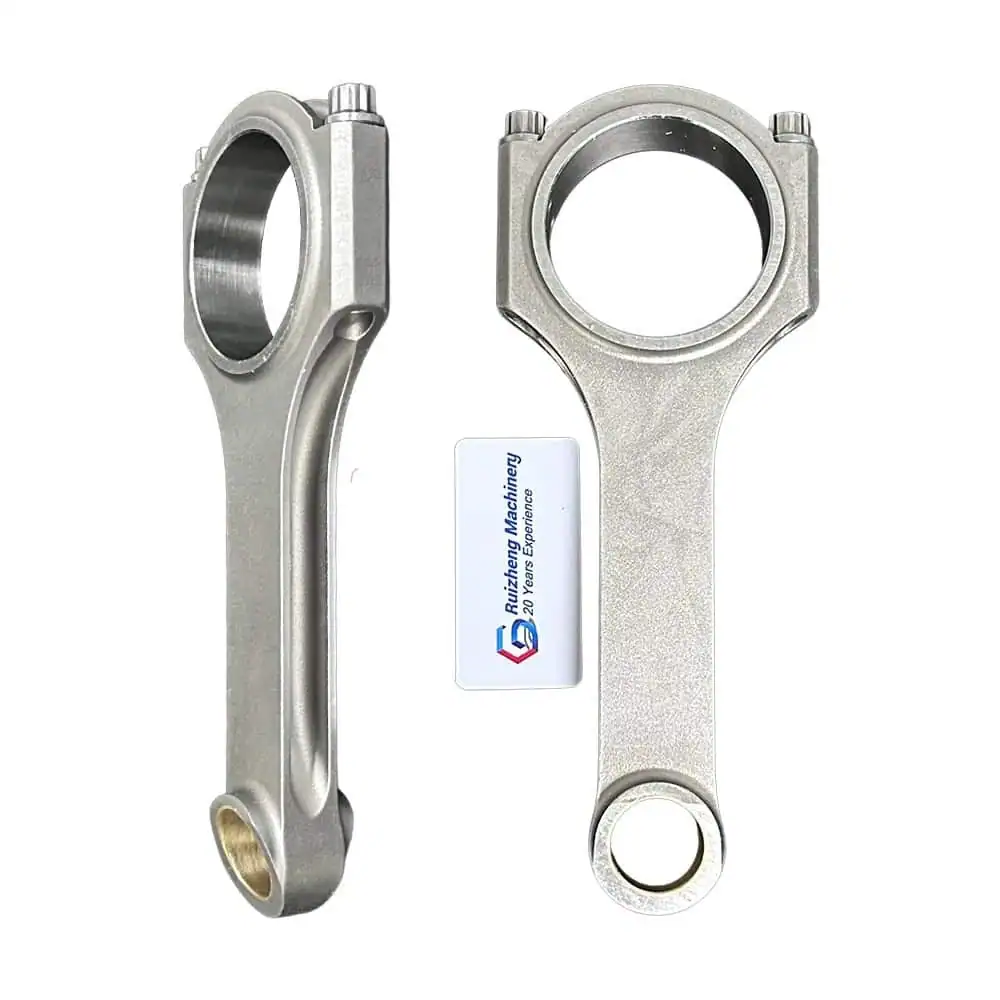
One Rod, Two Masses, Two Different Problems
The small end rides the reciprocating bill
Whatever mass sits at the small end accelerates vertically with the piston and stops twice a revolution to come back. Inertial load at the dead centres rises with the square of rpm. So a set whose small ends disagree shakes the block up and down — worst near the top of the tacho — and loads the cylinder walls unevenly, polishing rings and liners at different rates in different bores.
The big end rides the rotating bill
The big end circles the crankpin and joins the rotating assembly the crank’s counterweights were balanced against. Hand that mass out unevenly and main bearings work asymmetrically, the crank drifts toward whip at speed, and the assembly’s resonance region relocates somewhere nobody agreed to. Builders who’ve watched a mismatched set hunt through the rev range have watched precisely this.
Why total mass hides both stories
Different rod designs split the total between the ends differently. One H-beam here, another bolt package there, a bushing a hair heavier at the pin end. Two rods can match totals while one keeps its extra grams at the rotating end and the other at the reciprocating end. Worst pairing for balance that you can build, and a whole-rod weighing on a bench scale cannot see it at all.
How a Set Actually Gets Matched
Ends get weighed apart, over a jig
A rod balancing fixture stands the rod up — one end on a datum pin, the other resting on the scale — and every rod yields a big-end number and a small-end number as separate figures. Entry fee is a scale with tenth-of-a-gram resolution. Rods go on clean, caps torqued to spec. Find the lightest small end and the lightest big end. Nine times in ten they live on different rods. That is the whole reason the fixture exists.
Material comes off, never on
Matching means taking metal off the heavier units down to the lightest reference. Old sets had balance pads on the big-end and small-end exteriors for exactly this purpose. Modern H-beam sets often take the small-end reduction as an even belt-sander pass around the boss rather than a flat grind. What never gets touched: bolt bosses, bearing bores, beam faces, fillets. Those are where fatigue cracks go looking. Remove stock there and you’ve traded a vibration complaint for a far louder one. Heat is the quiet failure in this step — a cooked big end goes out of round and the metal itself changes. Careful shops cut light, quench often, re-check roundness after.
Weighed ends feed the next step
Those numbers don’t retire in the rod box. They feed the bobweight calculation for spin-balancing the crankshaft with flywheel, damper and clutch hardware present. A crank balanced against guessed rod masses is balanced against fiction. And a set earns fresh figures after any re-sizing, re-phosphating or bushing swap — old numbers describe parts that no longer exist.
Keeping the Spread Small in Manufacturing
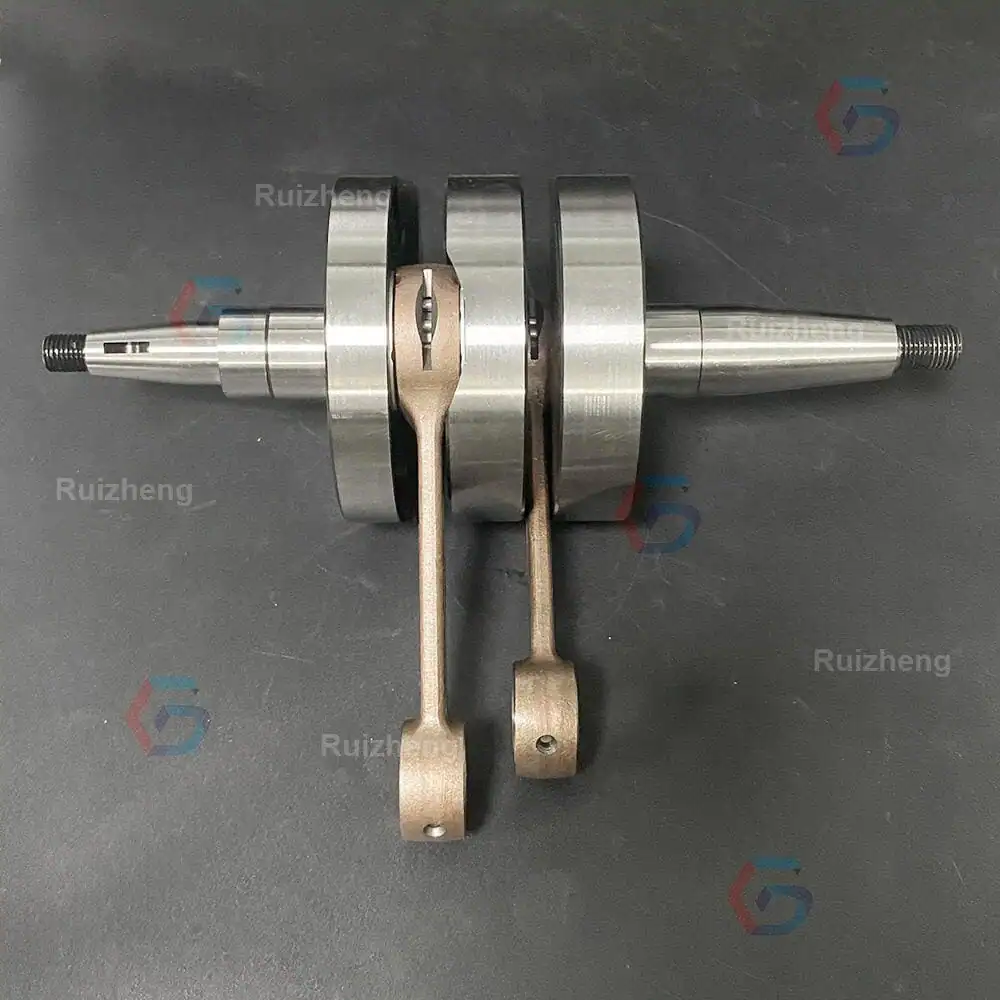
Rods that arrive matched spare the engine builder everything above, and that’s where a supplier’s process stops being a promise. Ruizheng’s version is boring in a good way. One setup runs the batch instead of re-dialling between pieces, so machined geometry stays symmetrical on its own. Critical dimensions land on the same ZEISS coordinate machine and Mitutoyo gauges inside the temperature-controlled room. Alloy stock arrives with material reports, so the starting bars are uniform before metal moves at all. When stock removal is genuinely needed, a machine with recorded positions beats a freehand grinder every time.
| What you can ask a supplier | What a good answer includes |
| Per-end weight data for the shipped set | small-end and big-end figures per rod, spread of the set |
| Where correction material may come from | named non-critical zones, explicit no-go areas |
| Process control across the batch | same-setup machining, in-process checks not just final |
| Measurement conditions | constant-temperature room, identified instruments |
| Traceability | material report and dimensional report with the shipment |
No honest shop prints a gram tolerance it never measured, so the demand worth making is the record, not the promise. Same logic covers rods ordered alongside a custom crankshaft: match half the rotating assembly, guess at the other half, and you’ve purchased a tidy parts shelf plus a still-buzzy engine.
A build sits right by trading real numbers early, not catalog claims late. End masses, cap orientation, what the reports will contain — a paragraph of questions through the contact page with the spreadsheet you already have. A teardown costs the week instead.
FAQ
How much spread across a set of rods is acceptable?
Talk per-end, not totals, and let the rev ceiling decide. A low-rev industrial unit or stock replacement shrugs off a gram of disagreement that a high-revving build will rattle over. Where nobody has measured anything, assume nothing. One afternoon on a jig settles it.
Should rods be weighed with caps, bolts and bushings installed?
Caps and bolts belong on the scale. Their mass joins the same rotating and reciprocating motions, torqued to the same figure at every weighing so comparisons stay honest. Bushings and the pin too, whenever the final stack is what matters — which is exactly why complete piston-pin-rod assemblies get re-weighed after any change to those pieces.
Does weight matching matter for a low-mileage rebuild with original rods?
More than builders expect. Factory sets ship matched to automotive tolerances, then every later operation — re-sizing, honing, peening, re-phosphating — moves the mass again. One per-end check during the rebuild takes an afternoon. Finding the set still tight is cheap relief. Finding it after assembly is the expensive kind of curiosity.

