
Operating industrial equipment under heavy radial loads and extreme rotational speeds instantly exposes any structural weakness in the mechanical design. When a custom machine tool spindle shaft lacks the proper metallurgical foundation, the resulting thermal distortion and microscopic vibrations directly destroy workpiece accuracy. For engineers and procurement teams, sourcing a reliable rotational component requires strict scrutiny of the raw materials and the thermal processing applied to them. Based in Foshan, Ruizheng specializes in precision CNC turning, milling, and grinding, providing industrial manufacturers with heavily engineered shaft components that maintain structural integrity under the most demanding cutting conditions.
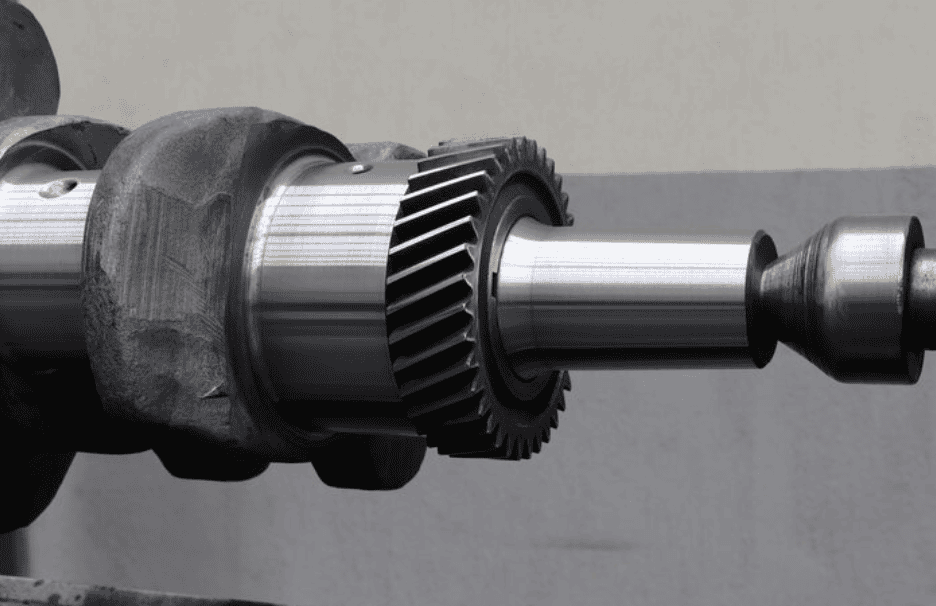
Why Do Spindle Shafts Fail Prematurely in Heavy-Duty Machining?
The spindle is the core component of any CNC machine. It is easy to bring a plant to a stand still if the spindle fails. Most mechanical failures prior to end of life are caused by the selection of metals that are not suitable to withstand the harsh conditions of continuous heavy duty machining.
Inadequate Core Toughness Leads to Sudden Fractures
High lateral force and shock loading is experienced by the spindle during aggressive milling. If the material selected does not contain adequate core toughness then continued impact will cause the formation of microscopic fatigue cracks within the material. These cracks can then be propagated by high speed rotation leading to sudden failure. Engineers select premium materials, such as 42CrMo, that possess high yield strength to enable absorption of impact loading without failure.
Poor Surface Hardness Accelerates Bearing Journal Wear
Friction between the shaft and the bearings will produce wear on the bearing journals. Unless the material of the shaft is hardened, wear will be fast. As the shaft wears, the tolerance will increase until the clearance between the shaft and the inner ring of the bearing will be so great that the shaft will vibrate in the bearing seats. This will, in turn, cause the assembly to fail in a short space of time.
Uncontrolled Thermal Expansion Distorts Machining Accuracy
Heavy cutting generates intense heat that travels directly into the spindle cartridge. Standard carbon steels expand unpredictably when exposed to continuous temperature increases. This uncontrolled thermal expansion causes the shaft to warp slightly off its true center. Even a minor distortion introduces significant spindle runout deviation, which transfers directly to the cutting tool and ruins the dimensional accuracy of the final machined workpiece.
How Does Proper Material Selection Prevent CNC Equipment Downtime?
To prevent failure, however, consideration must be given to selecting the correct alloy base prior to commencing the turning of the custom machine tool spindle shaft. The alloy base determines the behavior of the custom spindle shaft under conditions of stress, of heat and of high frequency vibration during its long operational life.
Premium Alloy Steels Withstand Extreme Radial Loads
Most metals have a ‘yield point’ and will fail under constant stress. For very heavy-duty work, special Chromium-Molybdenum alloys, like 42CrMo4 / 40Cr, are sometimes used for the very structural parts, as they offer the highest tensile strength and the deepest hardenability to create the stiffest of structures to withstand bending under very high feed rates for cutting.
Specialized Metals Reduce Harmful Harmonic Vibrations
A high-speed CNC spindle requires material with a highly uniform internal grain structure. Inconsistent metal density creates microscopic heavy spots. At 10,000+ RPM, these heavy spots cause harmonic resonance. By selecting premium, uniformly forged alloys and combining them with strict dynamic balancing protocols, manufacturers eliminate these destructive frequencies, protecting both the ceramic bearings and the carbide cutting inserts.
Tailored Material Matching Secures Bearing Fit
Different metals possess different coefficients of thermal expansion. A bearing fit that is perfectly tight at room temperature might become loose at operating temperature if the shaft material expands at a different rate than the bearing steel. Sourcing a dedicated custom machine tool spindle shaft ensures the manufacturing facility calculates these expansion rates. Engineers can then precisely machine the required interference or transition fits (such as m6 or k6) to match the specific alloy, preventing the bearing from slipping under load. For further details, see How Shaft Machining Affects the Best Material Choice for Drive Shafts.
| Material / Treatment | Core Toughness | Surface Hardness | Runout Risk at High Temp |
| Standard Carbon Steel (Untreated) | Low | Low (< HRC 20) | High |
| 42CrMo / 40Cr (Quenched & Tempered) | Excellent | Medium (HRC 28-32) | Moderate |
| 42CrMo (Tempered + Induction Hardened) | Excellent | High (HRC 58-62) | Very Low |
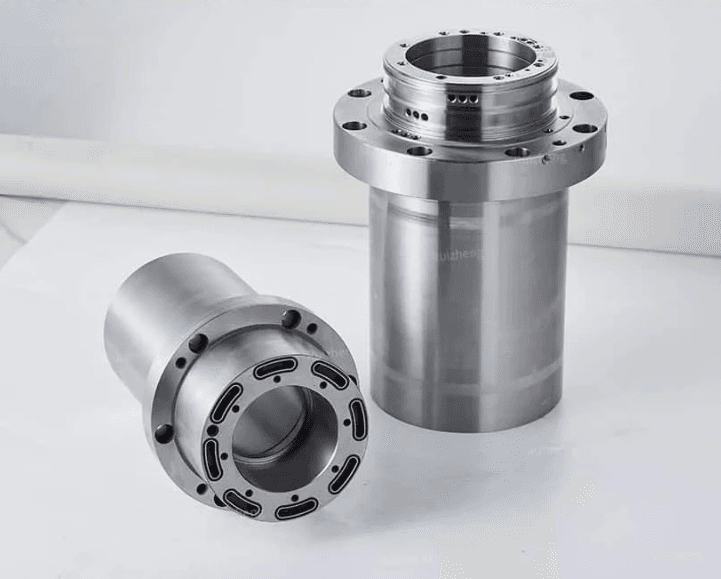
What Are the Essential Heat Treatment Processes for Spindle Shafts?
Raw material selection only dictates the potential of the shaft. It is the applied thermal processing that locks in the mechanical stability required for a custom machine tool spindle shaft to perform reliably.
Quenching and Tempering Optimize Internal Structures
Rough turning introduces severe internal mechanical stress into the raw steel. If ignored, this stress will slowly release over time, warping the finished part. Quenching and high-temperature tempering alter the micro-structure of the metal, relieving these trapped stresses. This process yields a uniform, highly stabilized core that will not warp during subsequent machining or long-term operation.
Precision Surface Hardening Protects Critical Bearing Journals
Bearing seats are also extremely hard and so manufacturers carry out high frequency or medium frequency induction hardening of the bearing seats. The surface hardness of this hardened outer layer is in the region of HRC 58-62 and this acts as a shield preventing wear to the bearing journal. Core is hard yet tough and ductile to allow for shock loads occasioned by cutting.
Constant-Temperature Grinding Eliminates Heat Distortion
The extreme heat of the hardening process inevitably causes slight micro-distortions in the metal. To achieve the final sub-micron tolerances, facilities must utilize precision cylindrical grinding. However, grinding generates its own heat. By integrating comprehensive heat treatment and precision CNC machining services, advanced factories perform all final grinding inside climate-controlled rooms. This constant-temperature grinding prevents environmental temperature fluctuations from affecting the metal, allowing the facility to hold concentricity and spindle runout deviation strictly within 0.001mm to 0.002mm.
How to Ensure Your Custom Spindle Meets Strict Engineering Standards?
Verifying the capabilities of a machining partner is a critical step for procurement managers. You must ensure the supplier has the physical infrastructure to measure and validate the tight tolerances required by your engineering drawings.
Request Thorough CMM Inspection Reports Before Assembly
Do not accept components based on visual checks. A reliable manufacturer relies on Coordinate Measuring Machines (CMM) and dedicated roundness testers to verify every geometric dimension. Implement strict procurement standards by requiring first-article inspection reports and 100% pre-shipment quality checks to ensure the batch complies with ISO quality management systems.
Submit Your CAD Drawings for Rapid Manufacturability Review
Complex shafts typically consist of stacked parts with very tight tolerances that look simple on paper but are difficult to machine. We like to engage with an engineering team to review your 2D CAD drawings or 3D CAD models within a few hours of receiving them. We will provide you with feedback on the suggested material, heat treatment depth required and cost efficiency within 24 hours.
Partner With an Experienced OEM for Reliable Delivery
To maintain stability in your supply chain, you need a supplier who can manage the entire life cycle of a part. Thus, you should choose a supplier who can do prototyping very fast, scaling up to full production and shipping in a safe and competitive DDP manner worldwide, so your production lines are never waiting for parts.
If your equipment assembly is struggling with uncontrolled thermal expansion, premature bearing journal wear, or difficult tolerance stack-ups, direct engineering collaboration provides immediate clarity. Our technical team is ready to review your project requirements, recommend the appropriate alloy and thermal processing, and evaluate manufacturing feasibility. You can contact our engineering specialists directly to submit your 2D/3D CAD drawings for a comprehensive material and tolerance assessment.
FAQ
What material is best for high-speed CNC spindle shafts?
For heavy-duty and high-speed CNC spindle applications, engineers consistently specify high-strength chromium-molybdenum alloys like 42CrMo or 40Cr. When engineered into a custom machine tool spindle shaft, these materials offer the necessary tensile strength and core toughness to absorb continuous radial shock loads without fracturing.
How does surface hardness affect bearing journals?
Un-treated metal degrades quickly under continuous rotational friction. Applying induction hardening to achieve HRC 58-62 on the specific mounting points prevents bearing journal wear. This high surface hardness maintains the exact micron-level interference fit required to keep the bearing inner ring firmly secured, preventing vibration.
Why is constant-temperature grinding necessary after heat treatment?
Heat treatment slightly warps the metal, and the friction from grinding introduces new heat that causes temporary expansion. Performing precision cylindrical grinding in a climate-controlled environment—known as constant-temperature grinding—neutralizes these thermal fluctuations. This environment is strictly required to machine a custom machine tool spindle shaft to a precise spindle runout deviation of 0.002mm or less.

