
A worn crankshaft gets one standard response: grind it, fit undersize bearings, run it again. Most of the time that’s money well spent. The shaft is already there. The bill is predictable. Yet the grinder works only on whatever metal is still standing. Shaft cracked? Bent past what a single pass can pull out? Already through two repairs? Then every further grind returns less life than the last one did. Finding that line is the real job. This article explains what reconditioning genuinely restores, when a new custom crankshaft costs less over the life of the engine, and what to have ready before ordering.
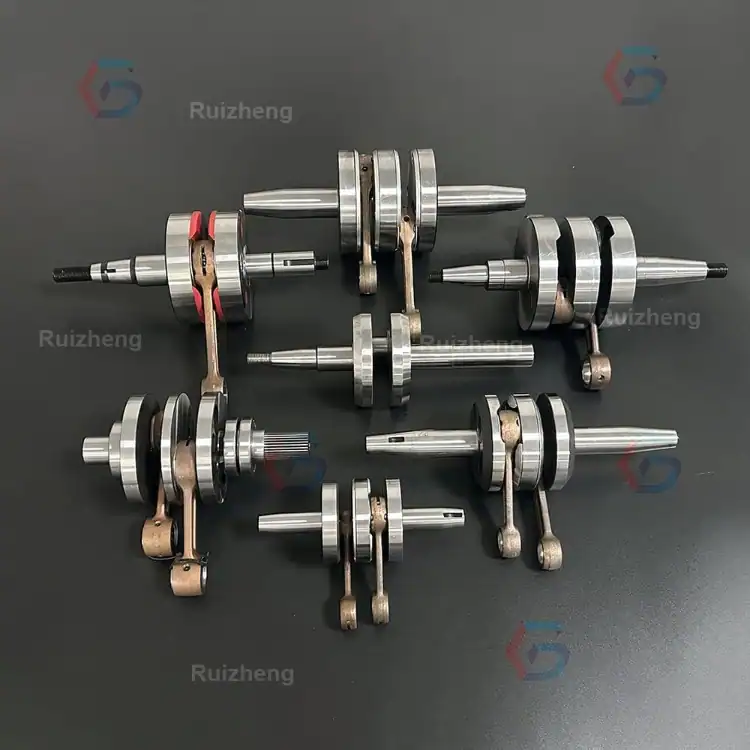
Ruizheng — full name Foshan Ruizheng Machinery Manufacturing Co., Ltd. — has been machining custom shaft parts since 2013. Small lathe shop back then. Now it’s turning, milling and grinding under one roof, a constant-temperature measuring room, robots handling the loading. ISO 9001 governs the shop. SGS test reports are on file. Orders ship to Europe, the United States, Japan and Southeast Asia — the same places they have gone for years. The custom crankshaft machining service takes on single-cylinder and multi-cylinder builds, inline or V-type, always from customer drawings. Want the machine list and the inspection setup? Both are published on the official website.
Where Does Reconditioning Stop Working?
Reconditioning assumes there’s still material to take off. True for a while. Then it isn’t.
What an Undersize Grind Can Fix
Uniform journal wear is the friendly case. Each main journal and pin journal goes down to the next undersize, matching bearings go in, the engine runs. Oil starvation that only kissed the surface? That often cleans up the same way. A careful grind brings back the journal finish the bearing depends on as well — which is why a good shop asks after surface roughness targets, not just the final diameter.
But notice what the grinder touched. Journal geometry. Nothing else.
The History You Inherit With a Used Shaft
Here’s the catch with a used shaft: its past comes along for free. Fatigue builds up over years of load reversals. Polished journals hide it. Nothing removes it. The heat treatment is whatever the first manufacturer picked, sized for a duty that may no longer apply. Earlier repairs may already have eaten stock nobody counted. A micrometer sees none of this. So what you’re really buying isn’t a component. It’s an unknown number of remaining cycles — cheap until it fails twice.
When Does a New Custom Crankshaft Win?
Three situations push a buyer off the fence. None of them is subtle once you’ve seen one.
After a Crack or a Straightness Problem
Cracks end the debate. Fatigue cracks like fillets and oil hole edges, and a regrind won’t slow one down; polishing certainly won’t. Straightness runs a close second. Bent past what straightening and grinding can pull out, the shaft will never hold runout in the assembly. See either at inspection and there’s no weighing to do. Cross reconditioning off.
When the Duty Cycle Has Changed
Engines drift away from their original jobs. A generator set specced for eight hours a day is suddenly running around the clock. A pump engine takes on loads the nameplate never mentioned. The old shaft did nothing wrong. The job moved. That’s a problem no repair can fix, because a reground shaft comes back matched to the job the engine used to do. A new custom crankshaft, with material and heat treatment picked for the workload it faces now, is the only answer aimed at the actual duty.
When You Are Paying for the Third Repair
Repair bills aren’t linear. First regrind: routine. Second: someone starts asking how much stock is left. By the third, the pattern has said its piece — this shaft, or this application, eats journals. Every repair costs money and lasts less. There’s a crossover in there, and good maintenance teams price it honestly. Tot up the repairs, add the downtime hours, set that against one new shaft with a declared starting condition. Past a certain count, the arithmetic picks the new part for you.
What to Have Ready Before You Order
Drawings decide most of a custom crankshaft before any metal is cut. Suppliers read them all day; the review before production is where the outcome gets settled, and it starts on your side of the table.
Drawings and Mating Parts
Entry ticket: a 2D drawing with tolerances, or a 3D model. What stops errors lives around it. Which bearings sit on the journals. Connecting rod big-end dimensions. Sealing and keyway interfaces. Send a drawing on its own and the quotation takes longer to be worth anything; name the mating parts up front and it’s sharp. Ruizheng reads submitted drawings and returns a quotation within 24 hours. Trial production and small batches are welcome too — prototype engines and low-volume equipment are exactly what that path exists for.
Picking Material and Heat Treatment
Materials on offer at Ruizheng: carbon steel, alloy steel, cast iron, plus stainless, aluminum and titanium. Treatment routes cover quenching, carburizing and nitriding. Choice follows duty. Cyclic loads that never let up? Forged alloy steel, hardened through, is where most shops land. Corrosion on the cards? Stainless. Unsure which way to go? Then say exactly that. Against your drawing, Ruizheng will suggest heat treatment routes and assembly tolerance recommendations, and nothing gets cut until both sides have signed off on them.
Inspection Proof Worth Agreeing On Early
Decide before ordering what proof travels with the batch. First-piece inspection, full-process inspection and final inspection before shipment are standard at Ruizheng. Material reports and dimensional inspection reports come on request. The shop holds machining accuracy to 0.001 mm and crankshaft tolerances within ±0.01 mm. Measurement happens in a temperature-controlled room, so a figure taken in July still means the same thing in January. Nail the checklist down early. Receiving inspection on your side then turns into a formality. No haggling at the dock.
Reconditioned or New, Compared Over the Whole Life
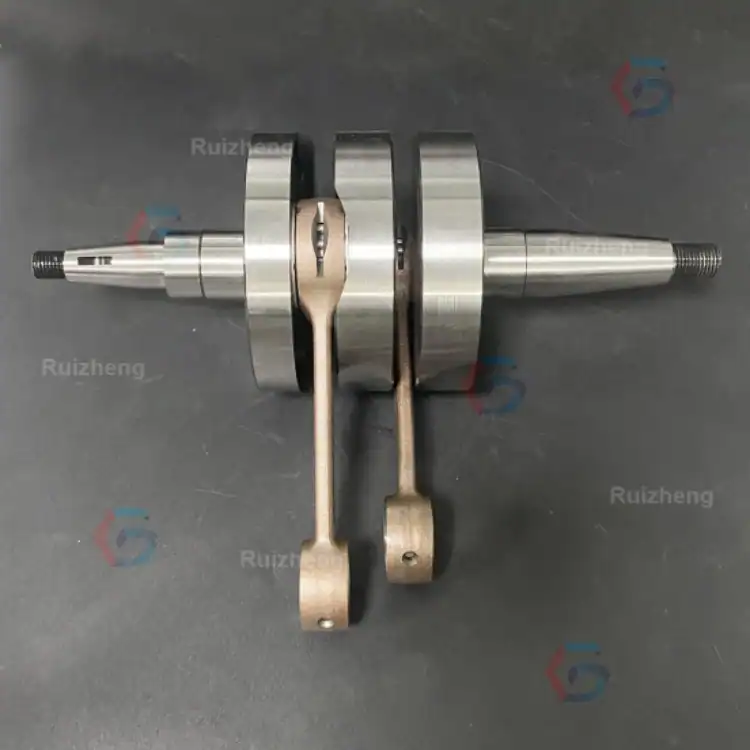
| Point | Reconditioned shaft | New custom crankshaft |
| Starting condition | Inherited wear plus unknown running hours | Declared material condition, machined to drawing |
| Geometry | Ground to whatever undersize the shaft has left | Built to the assembly, so no undersize is carried in |
| Material condition | Whatever the original build chose | Heat treatment matched to the current duty |
| Failure history | Known in part at best | None, and the batch opens with first-piece inspection |
| Cost profile | Low at the start; each repeat repair pushes it up | Front-loaded, then steady across the batch |
| Lead time | Days, sometimes a couple of weeks | 20–30 days ordinary; high-end precision 40–60 |
| Sensible when | Even wear so far, no cracks found | A crack, distortion, repeat failures, or a duty that moved on |
Don’t read the table as a verdict. It’s a decision aid. A healthy shaft on its first regrind? Nothing wrong with that — and pretending otherwise just burns money. Watch the right-hand column instead. Crack, bend, third repair, changed workload. Any one of those lands, and the reconditioned route stops being the bargain it looked like on the quote.
Sitting on a failed shaft and can’t tell which side of the line it’s on? Send what you have. The drawing, if one exists. The failure history. The application and its hours. Ruizheng reads drawings within 24 hours and will say plainly whether a repair makes sense or a new part does — contact is open for drawings, questions and sample requests.
FAQ
Will a 2D or 3D drawing be enough to get a custom crankshaft started?
Yes — send the 2D or 3D drawing and Ruizheng builds the non-standard part from it. A quotation comes back inside 24 hours, and trial production or a small batch can run before anyone commits to a full order.
What kind of lead time does a custom crankshaft need?
Count on 20–30 days for ordinary parts. High-end precision work takes 40–60 days, and a crankshaft with the full heat treatment and inspection paperwork almost always belongs to that second group. Material availability moves the schedule too, so raise your deadline at quotation stage.
Can heat treatment and material reports be supplied?
Yes. Quenching, carburizing and nitriding are available against the drawing, with material reports and dimensional inspection reports on request. Production runs under ISO 9001 — first-piece, in-process and final inspection — and a quality issue gets a defect analysis report, not a silent replacement.

