
CNC Machining for Robotics is not about holding every dimension to the smallest possible number. A robot cover, a mounting plate, and a rotating joint shaft do different jobs. Parts that control motion, alignment, torque transfer, or repeatable assembly usually deserve tighter control because small geometric errors can spread through the motion chain.
Ruizheng manufactures high-precision shaft components and custom non-standard mechanical parts for machine tools, industrial equipment, industrial robotic arms, and humanoid robots. Founded in 2013, the company combines turning, milling, grinding, and constant-temperature inspection, with machining accuracy reaching 0.001 mm for suitable parts and processes. For cnc machining for robotics projects, this capability matters most when tolerance is tied to part function. Learn more about Ruizheng.
Which Robotic Parts Need the Tightest Tolerances?
In cnc machining for robotics, the most critical controls usually sit around rotating interfaces, locating datums, drive components, and features that position one assembly relative to another.
| Part Type | Main Features to Review |
| Joint and rotating shafts | Diameter, runout, concentricity, shoulders |
| Servo and actuator shafts | Journal size, coaxial features, surface finish |
| Mounting and interface parts | Datums, hole position, flatness, perpendicularity |
| Covers and guards | General size, fit, clearance |
Robot Joint Shafts and Rotating Components Need Strong Geometric Control
For robot joint shaft machining, diameter tolerance alone is not enough. A shaft can meet nominal sizes and still create trouble if critical cylindrical features do not share the intended axis or if shoulders are not square to the reference diameter.
Runout, concentricity, and datum selection therefore matter more than simply writing tighter plus-or-minus values. In robotic arm CNC parts that transfer motion through a joint, controlling feature relationships supports cleaner assembly and more repeatable rotation.
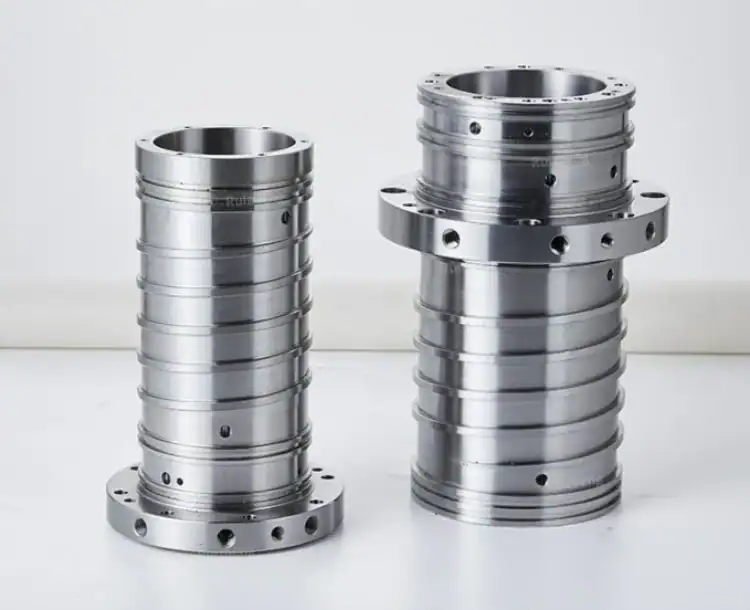
Ruizheng’s Custom Spindle Part is relevant for rotary components with multiple functional diameters, shoulders, and ground surfaces. For robot joint shaft machining, the benefit is coordinated turning, grinding, and inspection around the same functional axis.
Servo Motor and Actuator Shafts Need Consistent Rotational Accuracy
Servo motor shaft machining matters because drive shafts sit close to the source of motion. If journal size, coaxial features, or mating surfaces vary too much, assembly adjustment can increase.
Ruizheng also supplies Motor Shaft components. Buyers should identify the surfaces that control fit, rotation, and torque transfer. That is where servo motor shaft machining becomes a functional requirement.
Mounting and Interface Parts Need Accurate Datum Relationships
Robotic arm CNC parts such as mounting plates, flanges, sensor interfaces, and actuator supports can create assembly problems when the datum structure is unclear.
Ruizheng’s CNC Part service supports custom non-standard components from customer drawings. Buyers should identify locating faces, positioning holes, and clearance-only features. This keeps robotic component tolerances tight where they affect function.
Why Do Tight Tolerances Matter in Robotic Motion Systems?
The value of cnc machining for robotics appears in the relationship between parts. Several small errors can combine across a joint or drive assembly.
Runout and Concentricity Affect Rotational Stability
A shaft can pass a diameter check and still rotate around an unwanted axis. For precision CNC parts for robotics, buyers should define the inspection datum and make sure runout is checked in a way that reflects the assembled condition.
For more detail on radial and axial runout, see Ruizheng’s guide to CNC spindle shaft runout.
Tolerance Stack-Up Can Shift Alignment Across an Assembly
Robotic component tolerances should be reviewed as a chain. A locating bore, shaft shoulder, mounting face, and hole pattern may each be within specification while their combined variation still moves the final axis.
A useful drawing review asks:
- Which feature establishes the primary datum?
- Which dimensions position the motion axis?
- Which interfaces are assembled repeatedly?
- Which dimensions only provide clearance?
This protects performance while avoiding unnecessary precision.
Surface Finish and Heat Treatment Support Long-Term Fit and Wear Control
Dimension and geometry are only part of the decision. Material condition and surface finish also affect fitted or rotating interfaces.
Ruizheng works with alloy steel and stainless steel and supports heat treatment. For precision CNC parts for robotics, material selection should follow load, corrosion exposure, wear risk, and any post-treatment finishing requirement.
How Should Buyers Specify CNC-Machined Robot Parts?
A strong RFQ for cnc machining for robotics starts with function, not with “make everything as accurate as possible.” Clear functional information gives the manufacturer a better basis for process planning, inspection, and cost control.
Functional Datums and Critical Features Come First
Before assigning robotic component tolerances, separate functional features from ordinary geometry. Identify:
- primary and secondary datums;
- rotating and locating diameters;
- mounting faces and critical hole positions;
- shoulders that control axial location;
- mating surfaces with finish requirements.
Ruizheng supports custom production from 2D and 3D drawings and can provide assembly-tolerance suggestions for robotic arm CNC parts where several features must work together.
Material and Heat Treatment Should Match Load and Motion
Material selection should follow actual duty. Alloy steel may suit parts where strength, wear resistance, and heat-treatment response are central. Stainless steel can be useful where corrosion resistance matters.
For precision CNC parts for robotics, state the material grade, heat-treatment condition if required, and which surfaces will be finish-machined afterward. Leaving these items open can create avoidable revisions.
Inspection Requirements Should Be Defined Before Production
Inspection works best when planned before machining starts. Ruizheng applies first-piece inspection, in-process inspection, and final inspection before shipment, and uses a constant-temperature inspection room for precision measurement.
For cnc machining for robotics, the RFQ should state which characteristics require recorded inspection. Critical diameters, runout, datum relationships, hole positions, and mating surfaces should be separated from ordinary reference dimensions.
Where Do Ruizheng’s CNC Products Fit in a Robotics Project?
The right product category depends on the part’s function and the interfaces that control assembly.
Custom CNC Parts for Structural and Interface Components
CNC Part is a practical fit for brackets, flanges, mounting interfaces, supports, and other non-standard machined components. Buyers can tighten datums and locating features while keeping non-critical geometry at a more economical tolerance.
Custom Spindle Parts and Motor Shafts for Precision Motion
Custom Spindle Part fits components with coaxial diameters, shoulders, or ground surfaces tied to rotation. Motor Shaft has a smaller but specific role in servo-driven or actuator assemblies.
Buyers should define torque-transfer features, axial location, shared axes, and surfaces requiring final grinding.
Precision CNC Machining Services Support Prototype-to-Production Work
Ruizheng combines turning, milling, grinding, and inspection and supports sample and trial-production stages before batch orders. Its Precision CNC Machining Services are useful where one part requires several processes and datum transfer between operations must remain controlled.
For a cnc machining for robotics program, aligned process planning and inspection reduce handoff risk and make it easier to verify a sample before repeat production.
What Should Buyers Check Before Sending an RFQ?
A complete RFQ reduces clarification cycles and exposes risk before production.
A Complete Drawing Package Reduces Revision Cycles
Send a 2D drawing and, where available, a 3D model. Include:
- material and heat-treatment requirements;
- critical dimensions and geometric tolerances;
- surface-finish and datum requirements;
- inspection or reporting needs;
- prototype and expected production quantity.
Sample and Trial Production Reduce Batch Risk
Ruizheng supports samples and small-batch trial production. For parts with critical alignment or rotating features, a sample stage lets buyers verify fit, measurement method, datum interpretation, and inspection records before repeat production.
Ruizheng’s Drawing Review and Contact Process Moves the Project Forward
Ruizheng supports drawing evaluation and quotation within 24 hours for suitable inquiries. A useful first package includes the drawing, material requirement, critical tolerance list, expected quantity, and inspection need.
If your cnc machining for robotics project involves joint shafts, servo components, precision interfaces, or mixed turning-and-grinding requirements, send the drawing package and key inspection points through the Ruizheng contact page. A focused technical exchange at the RFQ stage can prevent tolerance misunderstandings from reaching sample or batch production.
FAQ
What Tolerances Are Most Important for CNC-Machined Robot Parts?
The most important tolerances are those tied to motion and assembly: rotating diameters, runout, coaxial relationships, locating faces, critical hole positions, and mating surfaces. In cnc machining for robotics, these features usually deserve more attention than cosmetic or clearance dimensions.
Do All Robotic Components Need Very Tight Machining Tolerances?
No. Static covers, guards, and non-locating features often do not need the same control as shafts, joint interfaces, and servo-related components. A functional tolerance strategy keeps precision where it protects performance and avoids paying for tighter machining where it adds no practical value.
What Should I Send a Supplier for a Robotics CNC Machining RFQ?
Send a 2D drawing, 3D model if available, material specification, heat-treatment requirement, critical tolerances, datum scheme, surface-finish needs, inspection requirements, and target quantity. For cnc machining for robotics, also identify the features that control rotation, alignment, or repeated assembly.

